
How to Write a CV That Gets You Hired in Switzerland
Sep 27, 2026
What does a CV that gets recruiters' attention actually look like?
After years of working in recruitment, including as a recruiter at Google and Meta, I've seen one consistent pattern:
Many strong candidates don't struggle because they lack experience.
They struggle because their CV doesn't translate their experience into value in a way recruiters can quickly understand.
A recruiter may only spend a short amount of time reviewing a CV before deciding whether to look more closely. Your experience may be impressive, but if the impact is hidden inside long descriptions of responsibilities, it becomes much harder to see.
This is particularly important when applying for competitive roles in Switzerland, where candidates may be competing with highly experienced professionals from different countries and backgrounds.
Your CV needs to make one thing clear:
Why should this company want to interview you?
Your CV is a translation of your professional value
A CV is not a complete record of your career.
It is a communication tool.
Recruitment processes often reduce complex professional journeys into a relatively simple set of signals: job titles, skills, keywords, achievements, experience and relevance to the position.
That means a recruiter may not immediately see the value behind everything you've done.
Your job is to make that value easier to understand.
Instead of simply describing what you were responsible for, show:
- what you changed;
- what you achieved;
- what problems you solved;
- what you improved;
- and what impact your work had.
1. Focus on achievements, not tasks
One of the most common CV mistakes is listing responsibilities instead of results.
For example:
Task-focused:
Managed paid advertising campaigns across Google and Meta.
Achievement-focused:
Managed Google and Meta campaigns that generated €1.2M in revenue while reducing customer acquisition cost by 24%.
The first tells the recruiter what you did.
The second gives them a reason to care.
A useful formula is:
Action + what you changed + measurable result
Not every achievement will have a perfect number attached to it. That's okay.
You can also demonstrate impact through:
- processes you improved;
- teams or projects you built;
- problems you solved;
- markets you entered;
- products you launched;
- efficiencies you created;
- or responsibilities that grew over time.
The important thing is to make the result of your work visible.
2. Use metrics to make your impact real
Numbers make achievements easier to understand.
Compare:
Increased sales.
with:
Increased annual sales by 38% within 12 months.
The second statement gives the recruiter context.
Useful metrics can include:
- revenue;
- growth rate;
- conversion rate;
- cost reduction;
- customer acquisition;
- retention;
- number of customers;
- size of budget managed;
- team size;
- project scope;
- market expansion;
- time saved;
- or operational improvements.
This is especially important for roles in technology, marketing, sales, finance and other performance-oriented functions, but measurable impact can strengthen a CV across many industries.
Don't invent numbers
If you don't know the exact figure, don't make one up.
Instead, look for evidence in:
- dashboards;
- reports;
- project documentation;
- performance reviews;
- budgets;
- CRM data;
- or emails and presentations from the time.
If an exact number genuinely isn't available, describe the impact accurately without creating false precision.
3. Show problem-solving and ownership
Leadership is not only about managing people.
You can demonstrate leadership through ownership.
For example:
Identified a gap in the customer onboarding process and redesigned the workflow, reducing average onboarding time by 30%.
This tells the recruiter several things at once:
You noticed a problem.
You took initiative.
You acted.
And something improved as a result.
That is often more informative than simply writing:
Responsible for customer onboarding.
When reviewing your CV, ask yourself:
What problems did I notice?
What did I change without being asked?
What did I take ownership of?
What became better because I was involved?
Those answers often contain your strongest CV bullets.
4. Make your CV relevant to the role
A strong CV is not necessarily the same CV you send to every company.
Before applying, compare your experience with the job description.
Identify:
- the most important requirements;
- recurring skills and keywords;
- the problems the company appears to be hiring someone to solve;
- and the achievements in your background that demonstrate those capabilities.
Then make sure those achievements are easy to find.
This doesn't mean copying the job description into your CV.
It means translating your real experience into language that is relevant to the role.
For example, if a company is looking for someone to “build a new function from scratch,” a bullet describing how you inherited an established process may be less relevant than an example where you created a new team, system or process.
5. Show what makes you different
This is one of the areas candidates often underestimate.
Many CVs look remarkably similar.
The same job titles.
The same lists of skills.
The same generic phrases:
Results-driven professional
Strong communication skills
Strategic thinker
Team player
These statements don't necessarily tell a recruiter much about you.
Differentiation comes from specific, meaningful evidence.
It could be:
- an unusual career path;
- experience across different markets;
- a distinctive combination of skills;
- building something from zero;
- a major career transition;
- an entrepreneurial project;
- unusual industry expertise;
- a significant personal achievement relevant to your professional story;
- or a particularly strong result.
For example, one detail I sometimes share from my own experience is that I funded more than CHF 65,000 of my education in Switzerland through my own performance and financial discipline.
That detail tells a story about initiative, commitment and long-term investment in development.
The lesson isn't that everyone should put a personal financial detail on their CV.
The lesson is:
Don't be afraid of meaningful details that make your story genuinely different.
6. Don't hide your career progression
If your responsibilities increased over time, make that visible.
For example:
Marketing Manager → Senior Marketing Manager → Head of Marketing
is much more informative when the CV also shows how your scope changed.
You can demonstrate progression through:
- increasing team responsibility;
- larger budgets;
- additional markets;
- more strategic ownership;
- larger revenue responsibility;
- or moving from execution into leadership.
Recruiters aren't only looking at what you did.
They are also looking for evidence of how your career developed.
7. Keep the CV sharp and intentional
More information does not automatically make a CV stronger.
Every line should earn its place.
For candidates with around eight years of experience or less, a one-page CV can often be a useful target if the relevant experience can be communicated clearly without sacrificing important information.
For more experienced professionals, a second page may be completely appropriate when there is substantial relevant experience to show.
The goal isn't to force your entire career onto one page.
The goal is to remove information that doesn't help the recruiter understand your fit for the role.
Ask yourself of every bullet:
Does this help demonstrate why I'm a strong candidate for this particular role?
If not, consider removing it, shortening it or moving it lower in the document.
8. Avoid generic CV language
Words such as “responsible for,” “worked on,” and “helped with” often make achievements sound passive.
Compare:
Responsible for managing a team of five marketers.
with:
Led a five-person marketing team responsible for €3M in annual acquisition spend.
The second version gives the recruiter much more information.
Look for opportunities to replace passive descriptions with specific actions:
Instead of:
“Responsible for improving the website.”
Try:
“Redesigned the conversion funnel, increasing trial sign-ups by 27%.”
Of course, only use the second version if it accurately reflects what you did.
9. Think about the recruiter who will read your CV
Before submitting your CV for a role in Switzerland, imagine that someone who knows nothing about your career has to understand your professional value in under a minute.
Would they immediately see:
- what you are good at;
- what level you operate at;
- what you have achieved;
- what problems you can solve;
- and why your experience is relevant to this role?
If not, the problem may not be your experience.
It may simply be the way that experience is presented.
A simple CV checklist
Before sending your CV, check whether it answers these questions:
Positioning
- Is it immediately clear what kind of role I'm targeting?
- Does my headline reflect my strongest professional positioning?
Experience
- Do my bullets focus on achievements rather than responsibilities?
- Have I included measurable results where they genuinely exist?
- Have I shown ownership and problem-solving?
Relevance
- Have I highlighted the experience most relevant to this specific role?
- Does my CV use the terminology and skills relevant to the position?
Differentiation
- Is there anything memorable about my professional story?
- Have I included meaningful details that distinguish me from similar candidates?
Clarity
- Can a recruiter understand my value quickly?
- Is the document concise?
- Does every section earn its space?
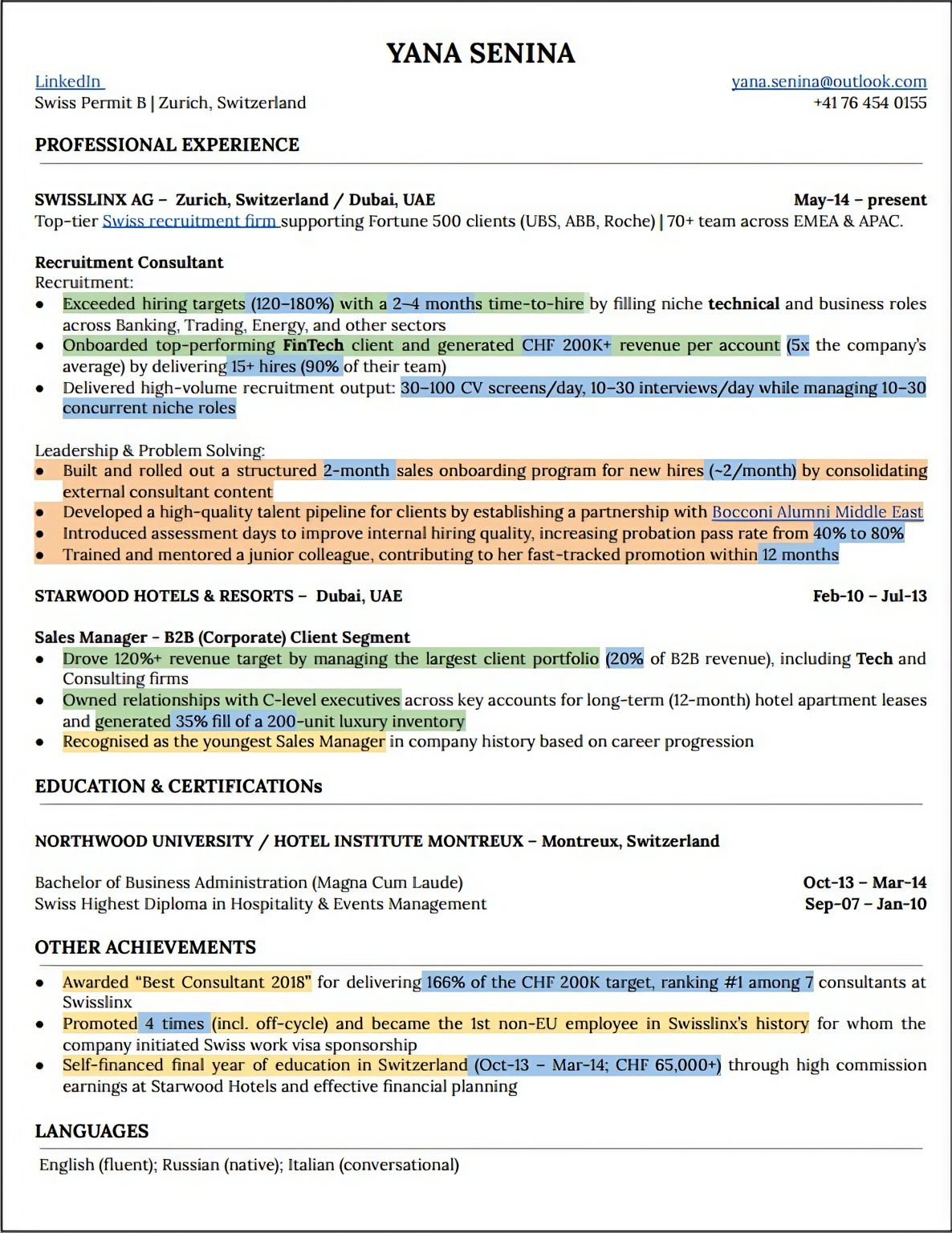
Take a closer look at the CV that got me hired at Google
Below, I've included the CV that helped me get hired at Google.
Use it as a reference point, not as a template to copy.
The most useful exercise is to look at how experience is presented:
- What achievements are prioritised?
- How are results communicated?
- Which information is left out?
- How is the candidate's professional story made clear?
- What makes the profile memorable?
Your CV doesn't need to look exactly like this one.
It needs to make your value easy to understand.
The goal isn't a perfect CV
There is no universal CV format that guarantees an interview.
Different companies, industries and roles will value different experience.
But one principle remains consistent:
Don't make the recruiter work to find your value.
Your experience is the raw material.
Your CV is how you translate it into a story that a recruiter can understand quickly and accurately.
And when you're applying for competitive roles in Switzerland, that clarity can make a meaningful difference in how your experience is perceived.
Get support when these questions actually come up
Salary questions, interviews, negotiations, and everything in between. Inside the Career Club, you don’t have to figure it all out alone.
Get structure, real recruiter feedback, and ongoing support throughout your job search.