
How to Use AI for Your Job Search: 9 Prompts for CVs, Interviews and Networking
Sep 24, 2026
Most people use AI to fix their CV.
The candidates who use it most effectively use it to prepare smarter.
There is a big difference between asking AI:
“Improve my CV.”
and giving it real context:
- your actual achievements;
- the job description;
- your current CV;
- examples of people already doing the role;
- the skills and experience the company is looking for.
The second approach does much more than polish your wording.
It can help you identify gaps in your experience, uncover achievements you may have overlooked, prepare stronger interview stories, and understand how to position yourself for a specific role.
For candidates searching for jobs in Switzerland, particularly in competitive international companies, this can make AI a useful part of your job-search preparation, rather than simply a CV-writing tool.
Why generic AI prompts don't work very well
A prompt like:
“Make my CV better.”
gives AI very little information to work with.
It doesn't know:
- what role you are targeting;
- what the company actually needs;
- which of your achievements are most relevant;
- how your experience compares with other candidates;
- or where your profile may have gaps.
The better approach is to give AI context first, then ask it to analyse.
Think of AI less as a copywriter and more as a job-search preparation partner.
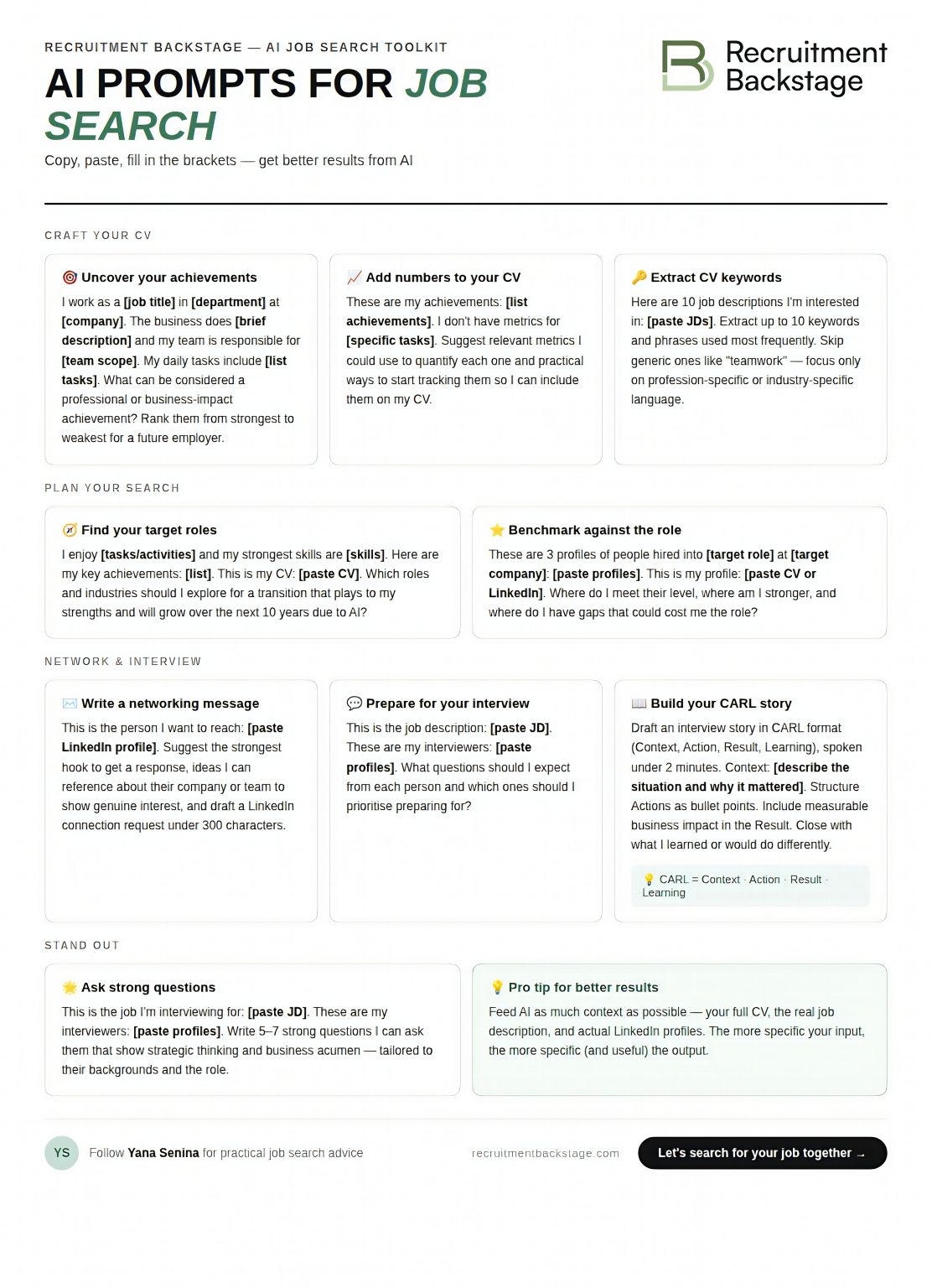
9 AI prompts to use in your job search
Below are nine prompts you can copy, paste and adapt to your own situation.
1. Find the achievements hidden in your experience
Sometimes the strongest achievements on your CV are not written as achievements yet.
Try:
“Here is my current CV and a list of projects I have worked on. Identify the achievements that demonstrate the strongest impact, using measurable results wherever possible. Ask me follow-up questions if important information is missing. Do not invent any results.”
This can help you uncover results you may have forgotten to include.
2. Match your experience to a specific job
Instead of asking AI to rewrite your CV immediately, first ask it to analyse the match.
“Here is my CV and the job description for a role I want to apply for. Identify the 5–10 strongest matches between my experience and the role. Then identify the most important requirements that my CV does not currently demonstrate clearly.”
This gives you a much more useful starting point than simply asking for a rewrite.
3. Identify your gaps
You can also use AI to challenge your assumptions.
“Compare my background with this job description. Separate the requirements into: strong match, partial match, and potential gap. For each potential gap, suggest what evidence from my experience I could use to address it. Do not exaggerate or invent experience.”
The goal isn't to make every candidate look like a perfect match.
It's to understand where you genuinely need stronger evidence.
4. Analyse people already doing the job
One of the most useful sources of information is often the profiles of people who already have the role you want.
You can give AI several LinkedIn profiles or public professional bios and ask:
“Analyse these profiles of people who currently hold similar positions. Identify the recurring skills, experiences, career paths and achievements. Compare these patterns with my background and tell me which strengths I should emphasise.”
This can help you understand what the market actually values for a particular position.
5. Prepare for the questions you are likely to get
Once AI understands the role and your background, use it to prepare for the interview.
“Based on this job description, my CV and the company's priorities, identify the 10 questions I am most likely to be asked in an interview. For each question, explain what the interviewer is trying to assess.”
This is much more useful than asking:
“Give me common interview questions.”
The more context you provide, the more relevant the preparation becomes.
6. Build stronger interview stories
AI can also help you turn real experience into structured interview answers.
“Here are several projects and challenges from my career. Identify which ones would make the strongest examples for behavioural interview questions. Map each story to questions it could answer using the STAR structure. Ask me for missing details rather than inventing them.”
The important part is “ask me for missing details rather than inventing them.”
AI should help you structure your real experience, not create achievements you never had.
7. Prepare your networking message
Generic networking messages often sound exactly like that: generic.
Instead, provide context about the person you're contacting.
“I want to contact this person because they work in [company/role/industry]. Here is their public profile and my background. Identify one or two genuine points of overlap and draft a short, natural LinkedIn message. Do not make it salesy and do not ask for a job in the first message.”
The goal is to start a relevant conversation, not immediately ask someone to help you get hired.
8. Prepare better questions for the interviewer
Your questions are also part of your interview performance.
Try:
“Based on this job description, company information and the interviewer's role, suggest 10 thoughtful questions I could ask at the end of the interview. Prioritise questions that demonstrate preparation, strategic thinking and genuine interest in the role. Avoid questions that are already answered in the job description.”
Then choose the questions that actually fit the conversation.
Don't ask a question simply because AI suggested it.
9. Create a final interview preparation brief
Finally, you can ask AI to bring everything together.
“Using my CV, the job description, company information and our previous analysis, create a one-page interview preparation brief. Include: the company's priorities, the key requirements of the role, my strongest relevant achievements, potential concerns or gaps, likely interview questions, my strongest stories, and 5 questions I should ask the interviewer.”
This gives you a single document to review before the interview.
The quality of the output depends on the quality of the context
The biggest mistake people make when using AI for job searching is expecting a good answer from a vague prompt.
Instead of:
“Make me a better candidate.”
give AI:
your CV + the job description + your achievements + relevant company information + examples of people in similar roles.
Then ask it to analyse the information before asking it to rewrite anything.
That is when AI becomes much more useful.
One important rule: never let AI invent your experience
AI can help you identify, structure and communicate your experience.
It should not create achievements, responsibilities, skills or results that you don't actually have.
Before using any AI-generated CV bullet, networking message or interview answer, check:
Is this accurate? Would I be comfortable explaining it in an interview? Can I provide evidence for it?
If the answer is no, change it.
Using AI for a Swiss job search
If you are applying for jobs in Switzerland, AI can be particularly useful for preparing for specific companies, roles and hiring processes.
You can use it to:
- analyse Swiss job descriptions;
- compare your experience with the requirements of a role;
- prepare for interviews with international teams;
- research the backgrounds of people in similar positions;
- prepare thoughtful questions for hiring managers;
- and identify areas where your CV or positioning may need more work.
But AI should support your preparation,
not replace your judgement.
The strongest job-search strategy is still based on understanding the company, knowing your own experience, and communicating the two clearly.
Save these 9 prompts
AI is most useful when you give it real information and ask it the right questions.
Don't use it only to make your CV sound better.
Use it to understand your positioning, find the strongest evidence in your experience, prepare for the interview and have better conversations with the people you meet during your job search.
Save these prompts and adapt them to your next application.
Get support when these questions actually come up
Salary questions, interviews, negotiations, and everything in between. Inside the Career Club, you don’t have to figure it all out alone.
Get structure, real recruiter feedback, and ongoing support throughout your job search.